Who is this for? Buyers, equipment engineers, maintenance teams
Goal: Understand what a flexible stainless-steel hose consists of, how to select it, and how to avoid failures—so you can brief suppliers in one go.
TL;DR
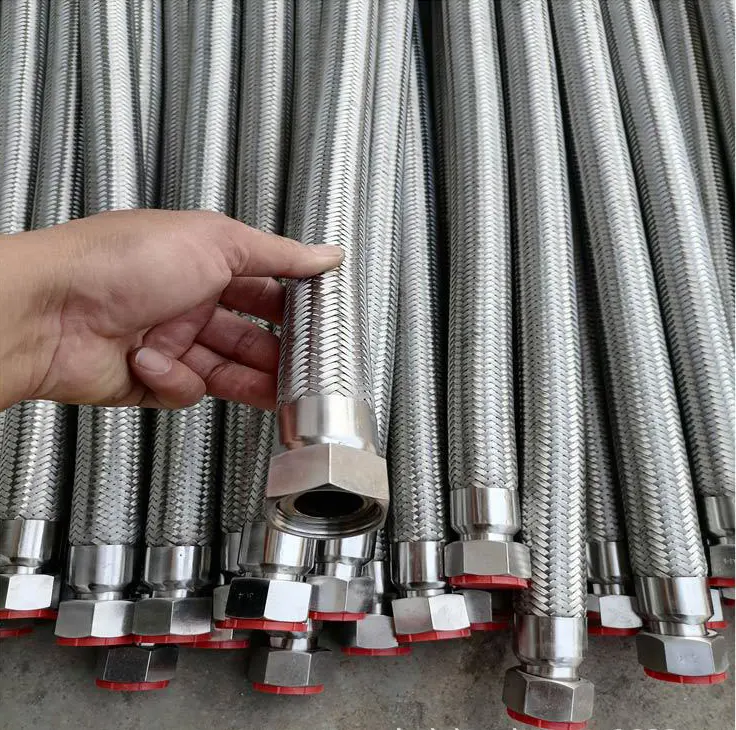
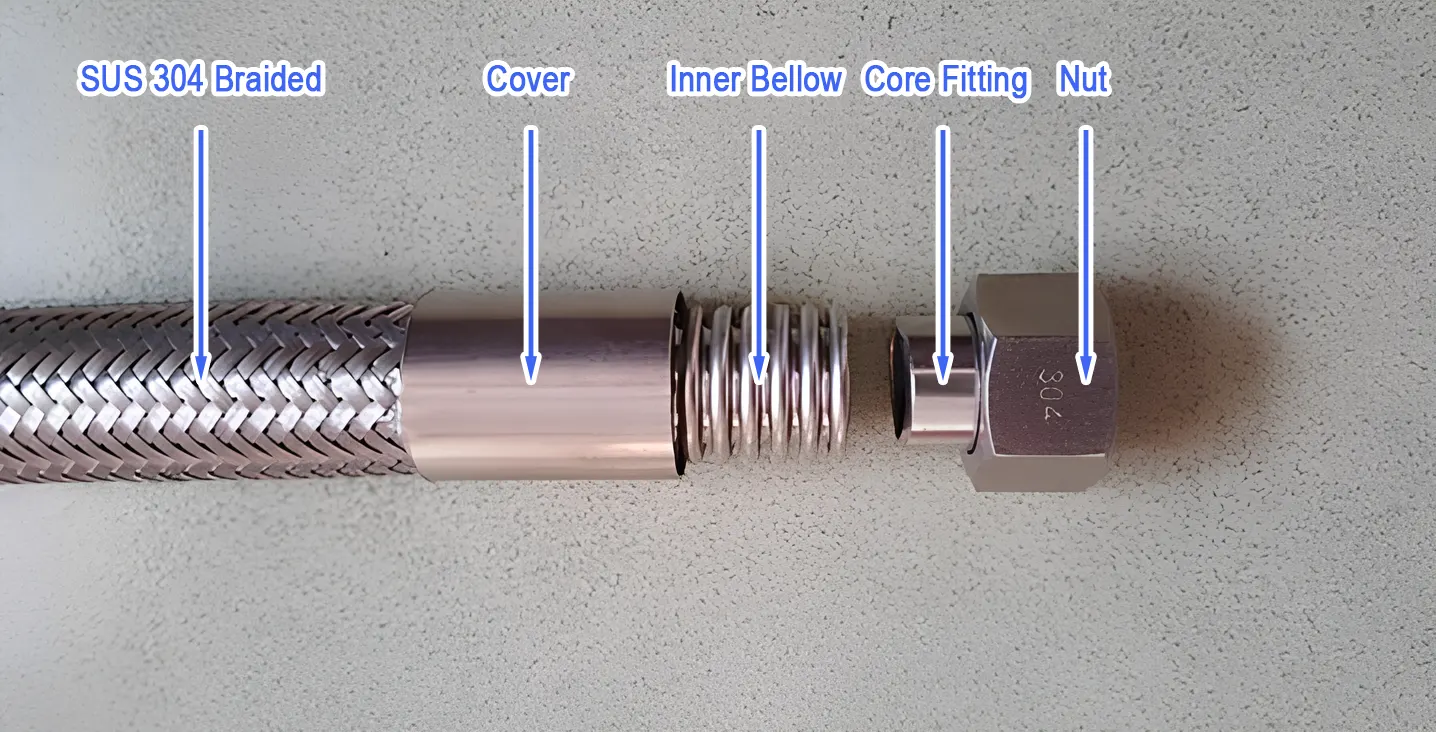
A typical flexible stainless-steel hose has four key parts:
- Corrugated inner core – provides flexibility and absorbs movement.
- Braided reinforcement layer (single/double/multi) – carries pressure and impact.
- Ferrule / braid collar – mechanically locks the braid to the fitting and enables full-penetration welding.
- End fittings (NPT/BSP/Flanges/Camlock/Tri-Clamp) – connect to your system and define the sealing method.
Send these 8 parameters for a fast quotation: medium, temperature, pressure/vacuum & pulsation, flow/pressure-drop (optional), minimum bend radius, connection standard, end-to-end length & tolerance, environment.
What Does It Consist Of?
1) Corrugated Inner Core
- Function: Flexibility, vibration damping, thermal expansion compensation.
- Materials: AISI 304/316L (choose 316L for chloride/corrosive environments).
- Geometries: Annular (higher pressure & fatigue life) or helical (easier to form/clean).
- Optional liners: PTFE liner for low friction, broad chemical compatibility, and hygienic service; smooth bore sleeves to reduce turbulence.
2) Stainless-Steel Braid (Reinforcement)
- Function: Takes internal pressure and limits radial growth of the core.
- Layers: Single for medium pressure; double/multi-layer for high pressure or frequent pulsation.
- Material: 304/316 (prefer 316 for marine/salt-spray).
- Tip: For water hammer/frequent starts, choose a denser weave or double braid.
3) Ferrule / Braid Collar
- Function: Securely locks the braid to the fitting; critical for pressure rating and service life.
- Build: Crimped or sleeve-type; high-end hoses use hydroforming + GTAW/TIG full-circumference welds.
4) End Fittings
- Threads: NPT, BSPP/BSPT, Metric.
- Flanges: ASME/ANSI, DIN/EN, JIS.
- Quick-connect / Hygienic: Camlock, Tri-Clamp.
- Seals: Metal-to-metal, O-ring, cone seal, or gasket—match medium and temperature.
Rule of thumb: For high-temperature steam use flanged ends + spiral-wound gasket; for frequent connects use Camlock/TC.
Sizes, Pressure Rating & Bend Radius
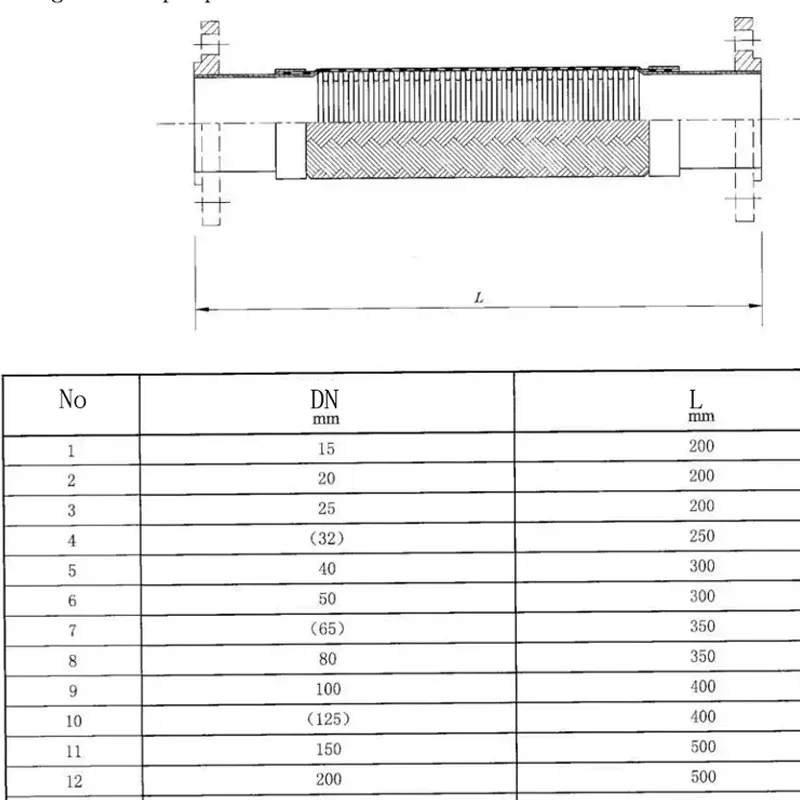
Nominal Sizes (Typical)
| DN | Typical ID (mm) | Typical OD (mm) | Common Threads/Flanges |
|---|---|---|---|
| 8 | 8 | 12–14 | 1/4″–3/8″ NPT/BSP |
| 15 | 15 | 20–22 | 1/2″–3/4″ NPT/BSP; DN15 flange |
| 25 | 25 | 32–36 | 1″ NPT/BSP; DN25 flange |
| 40 | 40 | 50–55 | 1½”–2″ thread; DN40/50 flange |
Dimensions vary by manufacturer; use your vendor’s datasheet for final selection.
Pressure Rating
- Depends on core wall thickness & corrugation, braid layer count & density.
- Datasheets list ratings at ~20 °C plus a temperature derating factor (e.g., ×0.6 at 400 °C).
- For pulsation/impact, keep a ≥2× safety factor and consider dampers/accumulators.
Minimum Bend Radius (MBR)
- Static vs dynamic reciprocating MBR differ (dynamic requires a larger radius).
- Radius is measured to the hose centerline.
- Avoid torsion; add swivel joints or orientation marks if needed.
Materials & Media Matching
| Application | Recommended Build | Notes |
|---|---|---|
| Water/Air (general) | 304 braid + 304 core | Cost-effective |
| Chlorides / Marine | 316L core + 316 braid | Pitting-resistant |
| Corrosives / Food & Pharma | PTFE-lined core + 316 fittings | Hygienic, low friction |
| High-temp Steam (≥180 °C) | 316L + flanged ends, metal gasket | Apply temperature derating |
| Vacuum | Annular core + protective cover | Prevents collapse; add vacuum support if needed |
Selection Checklist (copy & send to supplier)
- Medium (name, corrosivity, hygienic requirement)
- Temperature range (normal/peak/duration)
- Pressure (normal/max, pulsation? vacuum?)
- Flow / ΔP target (optional)
- Minimum bend radius & motion profile (static/dynamic; any torsion?)
- Connections (NPT/BSP/flange standard/quick-connect model)
- End-to-end length (with tolerance)
- Environment (outdoor/salt-spray/cleaners; need guard sleeve?)
- Standards/verification (e.g., ISO 10380, MTRs, hydrotest report)
Standards & Compliance
- ISO 10380 (metallic hose): type tests, cyclical life, pressure & bend testing.
- Also consider EN/DIN/ASME for flanges/materials/welding.
- Hygienic service: FDA, EU 10/2011 (for PTFE liners & seals).
Installation Essentials & Common Failures
7 Golden Rules
- No torsion: add orientation marks; use swivels if needed.
- Reserve bend: install with 1.2–1.5× MBR margin—don’t stretch straight.
- Use for misalignment—not as an expansion joint.
- Support & guide: long/vertical runs need hangers to avoid self-weight tension.
- Protect from heat/abrasion: guards and bend restrictors.
- Control water hammer: soft-start valves, accumulators, pulsation dampers.
- Weld quality: full